

Latest 300-710 Actual Free Exam Questions Updated 324 Questions
Free 300-710 Exam Braindumps certification guide Q&A
Cisco 300-710 exam is designed for professionals who want to validate their skills in implementing and managing Cisco Firepower Next-Generation Firewall (NGFW) solutions. With the increasing number of cyber threats, organizations are looking for skilled professionals who can secure their networks and protect their sensitive data. The Cisco 300-710 exam is an excellent way to demonstrate your expertise in this area and increase your credibility in the industry.
Exam Content
The content of the Cisco 300-710 test revolves around four domains, each containing specific knowledge and skills that the candidates must develop competency in. These areas have different percentage weights in the exam syllabus, which shows how many questions related to this or that topic will appear in the test. While preparing for your certification exam, you need to pay special attention to the sections with higher weight. However, you need to remember that only mastering all the topics will guarantee success in your test. The detailed outline of the domains covered in Cisco 300-710 is provided below.
- Deployment – 30%
Within this first topic, the examinees need to demonstrate that they have the relevant skills in implementing NGFW modes (including routed mode as well as transparent mode); implementing NGIPS modes (including passive & inline); implementing high availability options (including link redundancy, standby/active failover, multi-instance); describing IRB configurations.
- Configuration – 30%
This domain requires that the students have the expertise in a wide range of knowledge areas. For starters, they should have proficiency in configuring system settings within Cisco Firepower Management Center as well as configuring the policies, such as access control, malware & file, intrusion, identity, SSL, DNS, prefilter within Cisco Firepower Management Center. In addition, they need to able to customize the following features with the help of Cisco Firepower Management Center: network discovery, correlation, application detectors (Open AppID), and actions. This part also encompasses such skills as customizing objects with the help of Firepower Management Center (including object management as well as intrusion rules) and customizing devices with the help of Firepower Management Center (including device Management, VPN, NAT, QoS, Certificates, Platform Settings).
- Management & Troubleshooting – 25%
To tackle the questions associated with this subject area, the test takers should develop their competency in performing troubleshooting with the help of FMC CLI as well as GUI; customizing dashboards as well as reporting in FMC; troubleshooting with the help of packet capture actions; analyzing standard reports and risk.
- Integration – 15%
The last section in the Cisco 300-710 exam encompasses the individuals’ skills, such as customizing Cisco AMP for Networks within Firepower Management Center; configuring Cisco AMP for Endpoints within Firepower Management Center; implementing Threat Intelligence Director for third-party security intelligence feeds. Moreover, the learners should possess the expertise in describing the utilization of Cisco Threat Response for the needs of security investigations; describing Cisco FMC PxGrid Integration using Cisco Identify Services Engine (ISE); describing the functionality of Rapid Threat Containment (RTC) within Firepower Management Center.
Cisco 300-710 certification exam is designed for IT professionals who wish to demonstrate their expertise in securing networks with Cisco Firepower. 300-710 exam measures the test-taker's understanding of the Firepower Threat Defense (FTD) system, including its installation, configuration, and troubleshooting. Securing Networks with Cisco Firepower certification is ideal for network engineers, security professionals, and IT managers who are responsible for securing their organization's network infrastructure.
NEW QUESTION # 107
An engineer configures an access control rule that deploys file policy configurations to security zones or tunnel zones, and it causes the device to restart. What is the reason for the restart?
- A. The source tunnel zone in the rule does not match a tunnel zone that is assigned to a tunnel rule in the source policy.
- B. The source tunnel zone in the rule does not match a tunnel zone that is assigned to a tunnel rule in the destination policy.
- C. Source or destination security zones in the source tunnel zone do not match the security zones that are associated with interfaces on the target devices.
- D. Source or destination security zones in the access control rule matches the security zones that are associated with interfaces on the target devices.
Answer: D
NEW QUESTION # 108
What is a functionality of port objects in Cisco FMC?
- A. to add any protocol other than TCP or UDP for source port conditions in access control rules.
- B. to mix transport protocols when setting both source and destination port conditions in a rule
- C. to represent all protocols in the same way
- D. to represent protocols other than TCP, UDP, and ICMP
Answer: D
Explanation:
Reference:
https://www.cisco.com/c/en/us/td/docs/security/firepower/620/configuration/guide/fpmc-config- guide-v62/reusable_objects.html
NEW QUESTION # 109
An engineer needs to configure remote storage on Cisco FMC. Configuration backups must be available from a secure location on the network for disaster recovery. Reports need to back up to a shared location that auditors can access with their Active Directory logins. Which strategy must the engineer use to meet these objectives?
- A. Use SSH for backups and NFS for reports.
- B. Use SMB for both backups and reports.
- C. Use NFS for both backups and reports.
- D. Use SMB for backups and NFS for reports.
Answer: B
Explanation:
https://www.cisco.com/c/en/us/td/docs/security/firepower/640/configuration/guide/fpmc-config-guide-v64/system_configuration.html#ID-2241-00000551
"You cannot send backups to one remote system and reports to another, but you can choose to send either to a remote system and store the other on the Firepower Management Center."
NEW QUESTION # 110
An engineer is tasked with deploying an internal perimeter firewall that will support multiple DMZs Each DMZ has a unique private IP subnet range. How is this requirement satisfied?
- A. Deploy the firewall in transparent mode with access control policies.
- B. Deploy the firewall in routed mode with NAT configured.
- C. Deploy the firewall in transparent mode with NAT configured.
- D. Deploy the firewall in routed mode with access control policies.
Answer: B
Explanation:
Reference:
https://www.cisco.com/c/en/us/td/docs/security/asa/asa96/configuration/general/asa-96-general-config/intro-fw.h
NEW QUESTION # 111
IT management is asking the network engineer to provide high-level summary statistics of the Cisco FTD appliance in the network. The business is approaching a peak season so the need to maintain business uptime is high. Which report type should be used to gather this information?
- A. Standard Report
- B. Malware Report
- C. SNMP Report
- D. Risk Report
Answer: D
NEW QUESTION # 112
A network administrator is seeing an unknown verdict for a file detected by Cisco FTD. Which malware policy configuration option must be selected in order to further analyse the file in the Talos cloud?
- A. Sandbox analysis
- B. Spero analysis
- C. Dynamic analysis
- D. Malware analysis
Answer: C
Explanation:
Reference:
https://www.cisco.com/c/en/us/td/docs/security/firepower/60/configuration/guide/fpmc-config-guide-v60/Reference_a_wrapper_Chapter_topic_here.html
NEW QUESTION # 113
A company is deploying Cisco Secure Endpoint private cloud. The Secure Endpoint private cloud instance has already been deployed by the server administrator. The server administrator provided the hostname of the private cloud instance to the network engineer via email. What additional information does the network engineer require from the server administrator to be able to make the connection to Secure Endpoint private cloud in Cisco Secure Firewall Management Centre?
- A. IP address and port number for the connection proxy
- B. Username and password to the Secure Endpoint private cloud instance
- C. Internet access for the Secure End point private cloud to reach the Secure Endpoint public cloud
- D. SSL certificate for the Secure Endpoint ornate cloud instance
Answer: D
Explanation:
To connect to a Secure Endpoint private cloud instance from Cisco Secure Firewall Management Center (FMC), the network engineer requires the SSL certificate for the Secure Endpoint private cloud instance. This SSL certificate is necessary to establish a secure, trusted connection between the FMC and the private cloud instance.
Steps:
* Obtain the SSL certificate from the server administrator.
* Import the SSL certificate into the FMC.
* Configure the connection to the Secure Endpoint private cloud instance using the provided hostname and SSL certificate.
This ensures a secure and authenticated connection to the private cloud instance.
References: Cisco Secure Firewall Management Center Integration Guide, Chapter on Secure Endpoint Integration.
NEW QUESTION # 114
A network administrator reviews the file report for the last month and notices that all file types, except exe.
show a disposition of unknown. What is the cause of this issue?
- A. The malware license has not been applied to the Cisco FTD.
- B. Only Spero file analysis is enabled.
- C. A file policy has not been applied to the access policy.
- D. The Cisco FMC cannot reach the Internet to analyze files.
Answer: C
Explanation:
Explanation
A file policy defines the actions that the Cisco Firepower Threat Defense (FTD) device should take when it encounters different types of files. The file policy is applied as part of an access control policy. If an access control policy does not include a file policy, the FTD device will not take any action on the files it encounters, resulting in a disposition of "unknown" for all file types except exe.
Reference:
https://www.cisco.com/c/en/us/support/docs/security/firepower-ngfw/219759-configure-bypass-policies-on-the-c
NEW QUESTION # 115
An organization is migrating their Cisco ASA devices running in multicontext mode to Cisco FTD devices. Which action must be taken to ensure that each context on the Cisco ASA is logically separated in the Cisco FTD devices?
- A. Add the Cisco FTD device to the Cisco ASA port channels.
- B. Add a native instance to distribute traffic to each Cisco FTD context.
- C. Configure a container instance in the Cisco FTD for each context in the Cisco ASA.
- D. Configure the Cisco FTD to use port channels spanning multiple networks.
Answer: C
NEW QUESTION # 116 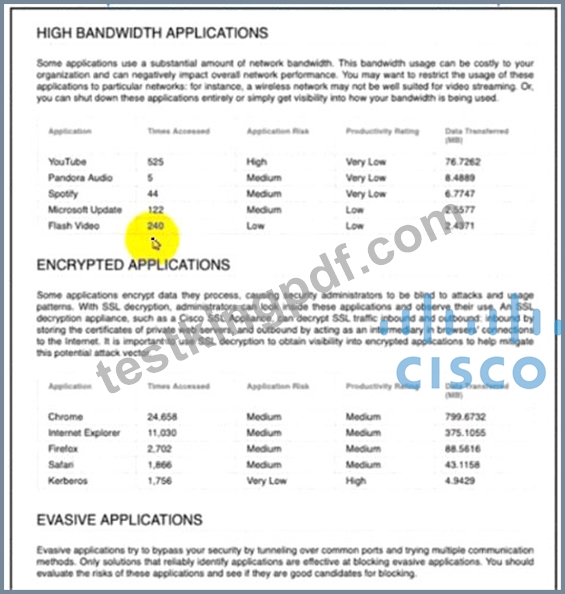

Refer to the exhibit. An engineer is analyzing a Network Risk Report from Cisco FMC. Which application must the engineer take immediate action against to prevent unauthorized network use?
- A. Chrome
- B. Kerberos
- C. YouTube
- D. TOR
Answer: D
NEW QUESTION # 117
A network administrator is trying to configure an access rule to allow access to a specific banking site over HTTPS. Which method must the administrator use to meet the requirement?
- A. Define the URL to be blocked and disable SSL inspection.
- B. Enable SSL decryption and specify the URL.
- C. Block the category of banking and define the application of WWW.
- D. Define the URL to be blocked and set the application to HTTP.
Answer: B
Explanation:
To allow access to a specific banking site over HTTPS, the network administrator must use SSL decryption (also known as SSL/TLS inspection) and specify the URL. This is because HTTPS traffic is encrypted, and the firewall needs to decrypt the traffic to inspect the URL and enforce the access rule.
Steps:
* Enable SSL Decryption: Configure SSL policies to decrypt the HTTPS traffic.
* Specify the URL: Define the URL of the banking site in the access control policy, ensuring that the decrypted traffic is inspected and allowed based on the specified URL.
This method ensures that only the desired banking site is accessed over HTTPS, while other HTTPS traffic can be filtered or blocked according to the organization's security policies.
References: Cisco Secure Firewall Management Center Configuration Guide, Chapter on SSL Decryption.
NEW QUESTION # 118
Which two statements about bridge-group interfaces in Cisco FTD are true? (Choose two.)
- A. Bidirectional Forwarding Detection echo packets are allowed through the FTD when using bridge-group members.
- B. The BVI IP address must be in a separate subnet from the connected network.
- C. Bridge groups are supported in both transparent and routed firewall modes.
- D. Each directly connected network must be on the same subnet.
- E. Bridge groups are supported only in transparent firewall mode.
Answer: C,D
NEW QUESTION # 119
Which two OSPF routing features are configured in Cisco FMC and propagated to Cisco FTD? (Choose two.)
- A. MD5 authentication to OSPF packets
- B. area boundary router type 1 LSA filtering
- C. OSPFv2 with IPv6 capabilities
- D. SHA authentication to OSPF packets
- E. virtual links
Answer: A,E
Explanation:
Reference: https://www.cisco.com/c/en/us/td/docs/security/firepower/620/configuration/guide/fpmc-config- guide-v62/ospf_for_firepower_threat_defense.html
NEW QUESTION # 120
What is a characteristic of bridge groups on a Cisco FTD?
- A. Routing between bridge groups is achieved only with a router-on-a-stick configuration on a connected router
- B. In transparent firewall mode, routing between bridge groups is supported
- C. In routed firewall mode, routing between bridge groups is supported.
- D. In routed firewall mode, routing between bridge groups must pass through a routed interface.
Answer: C
Explanation:
Reference:
https://www.cisco.com/c/en/us/td/docs/security/asa/asa97/configuration/general/asa-97-general-config/intro-fw.pdf
NEW QUESTION # 121
What is a limitation to consider when running a dynamic routing protocol on a Cisco FTD device in IRB mode?
- A. Only nonbridge interfaces are supported.
- B. Only EtherChannel interfaces are supposed.
- C. Only distance vector routing protocols are supported.
- D. Only link-stale routing protocols are supported.
Answer: A
Explanation:
Explanation
Integrated routing and bridging (IRB) is a feature that allows you to route between different bridge groups on a Cisco FTD device. A bridge group is a logical interface that acts as a container for one or more physical or logical interfaces that belong to the same layer 2 broadcast domain. You can assign an IP address to a bridge group interface (BVI) and enable routing protocols on it, just like a regular routed interface. However, when you run a dynamic routing protocol on a Cisco FTD device in IRB mode, you can only use nonbridge interfaces as routing peers. You cannot use bridge group interfaces or bridge group member interfaces as routing peers2. This is because the routing protocol packets are sent and received on the nonbridge interfaces, and the bridge group interfaces are used only for forwarding data traffic3.
NEW QUESTION # 122
Refer to the exhibit.
And engineer is analyzing the Attacks Risk Report and finds that there are over 300 instances of new operating systems being seen on the network How is the Firepower configuration updated to protect these new operating systems?
- A. The administrator manually updates the policies.
- B. Cisco Firepower automatically updates the policies.
- C. Cisco Firepower gives recommendations to update the policies.
- D. The administrator requests a Remediation Recommendation Report from Cisco Firepower
Answer: C
Explanation:
Explanation
Ref:
https://www.cisco.com/c/en/us/td/docs/security/firepower/60/configuration/guide/fpmc-config-guide-v60/Tailori
NEW QUESTION # 123
An engineer needs to configure remote storage on Cisco FMC. Configuration backups must be available from a secure location on the network for disaster recovery. Reports need to back up to a shared location that auditors can access with their Active Directory logins. Which strategy must the engineer use to meet these objectives?
- A. Use SSH for backups and NFS for reports.
- B. Use SMB for both backups and reports.
- C. Use NFS for both backups and reports.
- D. Use SMB for backups and NFS for reports.
Answer: B
Explanation:
https://www.cisco.com/c/en/us/td/docs/security/firepower/640/configuration/guide/fpmc-config-guide-v64/system
"You cannot send backups to one remote system and reports to another, but you can choose to send either to a remote system and store the other on the Firepower Management Center."
NEW QUESTION # 124
A security engineer is configuring an Access Control Policy for multiple branch locations These locations share a common rule set and utilize a network object called INSIDE_NET which contains the locally significant internal network subnets at each location What technique will retain the policy consistency at each location but allow only the locally significant network subnet within the applicable rules?
- A. creating a unique ACP per device
- B. utilizing policy inheritance
- C. creating an ACP with an INSIDE_NET network object and object overrides
- D. utilizing a dynamic ACP that updates from Cisco Talos
Answer: C
NEW QUESTION # 125
When deploying a Cisco ASA Firepower module, an organization wants to evaluate the contents of the traffic without affecting the network. It is currently configured to have more than one instance of the same device on the physical appliance Which deployment mode meets the needs of the organization?
- A. inline mode
- B. passive monitor-only mode
- C. inline tap monitor-only mode
- D. passive tap monitor-only mode
Answer: B
NEW QUESTION # 126
An administrator must use Cisco FMC to install a backup route within the Cisco FTD to route traffic in case of a routing failure with the primary route. Which action accomplishes this task?
- A. Configure EIGRP routing on the FMC to ensure that dynamic routes are always updated.
- B. Install the static backup route and modify the metric to be less than the primary route.
- C. Create the backup route and use route tracking on both routes to a destination IP address in the network.
- D. Use a default route on the FMC instead of having multiple routes contending for priority.
Answer: B
NEW QUESTION # 127
Drag and drop the steps to restore an automatic device registration failure on the standby Cisco FMC from the left into the correct order on the right. Not all options are used.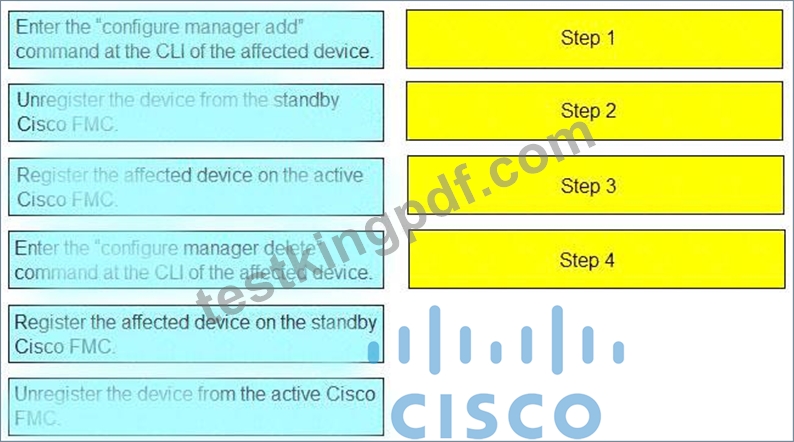
Answer:
Explanation:
Explanation
Explanation
Reference: https://www.cisco.com/c/en/us/td/docs/security/firepower/620/configuration/guide/fpmc-config- guide-v62/firepower_management_center_high_availability.html#id_32288
NEW QUESTION # 128
......
300-710 Certification Overview Latest 300-710 PDF Dumps: https://prepaway.testkingpdf.com/300-710-testking-pdf-torrent.html
