

Updated Apr 21, 2026 Verified Pass UiPath-ADPv1 Exam in First Attempt Guaranteed
Free UiPath-ADPv1 Sample Questions and 100% Cover Real Exam Questions (Updated 206 Questions)
UiPath UiPath-ADPv1 Exam Syllabus Topics:
| Topic | Details |
|---|---|
| Topic 1 |
|
| Topic 2 |
|
| Topic 3 |
|
| Topic 4 |
|
NEW QUESTION # 64
Which of the following examples accurately demonstrates using LINQ to perform data operations in a UiPath process?
- A. Applying LINQ to convert a list of integers to a JSON format by writing listOflntegers.ToJSON().
ToList(). - B. Utilizing LINQ to split a DataTable into multiple smaller DataTables based on a specific condition by writing dataTable.Splitf'ColumnName = 'Condition'").CopyToData Tablet).
- C. Using LINQ to filter DataTable rows based on a specific condition by writing dataTable.
AsEnumerable().Where(Function(row) row("ColumnName").ToString.Contains("Value")).
CopyToDataTable(). - D. Employing LINQ to concatenate two strings in a list by writing listOfStrings.Concatenate("String_1",
"String_2").ToList().
Answer: C
Explanation:
LINQ (Language-Integrated Query) is a feature of .NET that allows you to write queries to manipulate data from various sources, such as arrays, collections, databases, XML, etc. LINQ can be used in UiPath Studio to perform complex data operations on variables of different types, such as DataTable, List, Array, etc. LINQ has two syntax forms: query syntax and method syntax. Both forms can achieve the same results, but they have different styles and preferences.
Option B is the correct answer because it demonstrates using LINQ method syntax to filter DataTable rows based on a specific condition. The expression dataTable.AsEnumerable().Where(Function(row) row ("ColumnName").ToString.Contains("Value")).CopyToDataTable() does the following:
* It converts the DataTable variable dataTable to an IEnumerable(Of DataRow) object using the AsEnumerable extension method1. This allows the use of LINQ methods on the DataTable.
* It filters the rows of the DataTable based on a lambda expression using the Where extension method2.
The lambda expression Function(row) row("ColumnName").ToString.Contains("Value") returns true for the rows that have the value "Value" in the column named "ColumnName".
* It converts the filtered IEnumerable(Of DataRow) object back to a DataTable using the CopyToDataTable extension method3. This returns a new DataTable that contains only the rows that match the condition.
The other options are incorrect because:
* Option A is incorrect because it uses an invalid LINQ method Concatenate. The correct method to concatenate two strings in a list is Concat4, which takes two IEnumerable(Of T) objects as arguments and returns a new IEnumerable(Of T) that contains the elements from both sources. For example, listOfStrings.Concat(new List(Of String) {"String_1", "String_2"}).ToList().
* Option C is incorrect because it uses an invalid LINQ method ToJSON. There is no such method in the LINQ library that can convert a list of integers to a JSON format. To achieve this, you need to use a JSON serializer, such as Newtonsoft.Json5, which provides methods to convert .NET objects to JSON and vice versa. For example, JsonConvert.SerializeObject(listOfIntegers).
* Option D is incorrect because it uses an invalid LINQ method Split. There is no such method in the LINQ library that can split a DataTable into multiple smaller DataTables based on a specific condition. To achieve this, you need to use a group by clause in LINQ query syntax or a GroupBy extension method in LINQ method syntax6, which groups the rows of a DataTable by a key value and returns an IEnumerable(Of IGrouping(Of TKey, TElement)) object. Then, you can use a Select extension method to project each group into a new DataTable using the CopyToDataTable extension method. For example, dataTable.AsEnumerable().GroupBy(Function(row) row("ColumnName")).Select (Function(group) group.CopyToDataTable()).ToList().
References:
DataTableExtensions.AsEnumerable Method (System.Data) | Microsoft Docs
Enumerable.Where(Of TSource) Method (System.Linq) | Microsoft Docs
DataTableExtensions.CopyToDataTable(Of T) Method (System.Data) | Microsoft Docs Enumerable.Concat(Of TSource) Method (System.Linq) | Microsoft Docs Json.NET - Newtonsoft Grouping Data - C# | Microsoft Docs
NEW QUESTION # 65
What is the output type returned when using a Get Test Data Queue Item activity?
- A. Object
- B. Queueltem
- C. Dictionary
Answer: B
NEW QUESTION # 66
While working in an RPA testing project, you encountered the following activity in one of the workflows included in the project.
What action can you perform in your mocked file to replace the functionality of the MessageBox with a LogMessage during mock testing?
- A. Surround activity with mock.
- B. Create mock workflow.
- C. Synchronize mock.
- D. Remove mock activity.
Answer: A
Explanation:
To replace the functionality of the MessageBox with a LogMessage during mock testing, the developer can perform the action of Surround activity with mock. This action inserts a mock activity around the selected activity, which allows the developer to change the behavior of the activity for testing purposes. For example, the developer can right-click on the MessageBox activity and select Surround activity with mock from the dropdown menu. This will create a mock activity that contains the MessageBox activity. The developer can then edit the mock activity and replace the MessageBox activity with a LogMessage activity, which will write the message to the output panel instead of displaying it in a dialog box. This way, the developer can test the functionality of the workflow without having to interact with the MessageBox dialog box. References: [Mock Testing], [Surround Activity with Mock]
NEW QUESTION # 67
How does UiPath Integration Service benefit automation developers?
- A. By substituting the requirement for API automation with UI automation capabilities, delivering a more manageable and user-friendly approach, allowing users to streamline their processes efficiently and effectively facilitating a more rapid integration process.
- B. By standardizing authorization and authentication, managing API connections, and enabling faster integration into SaaS platforms.
- C. By enabling developers to create custom UI elements for applications without using APIs.
- D. By offering a comprehensive, unified platform dedicated solely to UI automation, enabling seamless integration with third-party applications.
Answer: B
Explanation:
UiPath Integration Service is a feature of UiPath Automation Cloud that allows you to connect to various external applications and systems using predefined connectors. A connector is a component that provides the logic and interface for interacting with a specific application or system. A connection is an instance of a connector that is configured with the credentials and parameters required to access the application or system.
UiPath Integration Service benefits automation developers by standardizing authorization and authentication, managing API connections, and enabling faster integration into SaaS platforms. By using UiPath Integration Service, automation developers can:
Use a consistent and secure way of authenticating and authorizing access to different applications and systems, such as OAuth 2.0, API keys, or basic authentication.
Manage and reuse connections across multiple automation projects, and share them with other developers using UiPath Orchestrator folders and permissions.
Integrate with popular SaaS platforms, such as Microsoft Outlook 365, Salesforce, Google Sheets, and more, using the built-in connectors and activities that are available in UiPath Studio and other products.
Trigger automations based on events or actions that occur in the external applications or systems, such as receiving an email, creating a record, or updating a spreadsheet.
Build custom connectors for any system integration using the Connector Builder, which allows you to create and publish connectors based on third-party APIs.
The correct answer is B. By standardizing authorization and authentication, managing API connections, and enabling faster integration into SaaS platforms. This statement accurately describes how UiPath Integration Service benefits automation developers.
The other options are not correct statements. Option A is incorrect, because UiPath Integration Service does not substitute the requirement for API automation with UI automation capabilities, but rather combines them and allows both capabilities to be centrally accessed within the same integration design environment. Option C is incorrect, because UiPath Integration Service does not offer a comprehensive, unified platform dedicated solely to UI automation, but rather a component of the UiPath Platform that makes the automation of third-party applications easier by using both UI and API automation. Option D is incorrect, because UiPath Integration Service does not enable developers to create custom UI elements for applications without using APIs, but rather to create custom connectors for applications using APIs.
References: Integration Service - Introduction - UiPath Documentation Portal, New UiPath Integration Service
| UiPath, Introducing UiPath Integration Service | UiPath Resources
NEW QUESTION # 68
In the Global Exception Handler, which arguments are provided by default and should not be removed?
- A. errorinfo with the "In" direction result with the *ln/Ouf direction
- B. errorinfo with the "In" direction result with the "Out" direction
- C. errorinfo with the "In" direction result with the "In" direction
- D. errorinfo with the "Out" direction result with the "In/Out" direction
Answer: B
Explanation:
The Global Exception Handler is a type of workflow that determines the project's behavior when encountering an execution error. It has two arguments that are provided by default and should not be removed. They are:
* errorinfo: This argument has the "In" direction and it stores information about the error that was thrown and the workflow that failed. It can be used to log the error details, get the name of the activity that caused the error, or count the number of retries1.
* result: This argument has the "Out" direction and it is used to specify the next action of the process when it encounters an error. It can have one of the following values: Continue, Ignore, Retry, or Abort. These values determine whether the exception is re-thrown, ignored, retried, or stops the execution1.
The other options are not correct, because they either have the wrong direction for the arguments, or they use the "In/Out" direction, which is not valid for the Global Exception Handler arguments1.
References:
1: Studio - Global Exception Handler - UiPath Documentation Portal
NEW QUESTION # 69
A developer is building an automation which types text into a text file. The Activity Project Settings tor UI Automation Modern activities are set as follows:
The developer has configured the properties of a Type Into activity as follows:
What is the behavior of the Type Into activity when executing the workflow?
- A. The activity will remove Multi Line in Run mode and a Single Line in Debug mode.
- B. The activity will remove a Single Line in Run mode and in Debug mode.
- C. The activity will remove a Single Line in Run mode and Multi Line in Debug mode.
- D. The activity will use only properties set in Activity Project Settings.
Answer: C
Explanation:
The behavior of the Type Into activity when executing the workflow is that the activity will remove a Single Line in Run mode and Multi Line in Debug mode. This is because the activity has the Empty field property set to NEmptyFieldMode.SingleLine, which means that the activity will delete the existing content in the field by sending Ctrl+A and Delete keystrokes before typing the text. However, the activity also has the Debug mode property set to NEmptyFieldMode.MultiLine, which means that the activity will delete the existing content in the field by sending Ctrl+A, Shift+Home, and Delete keystrokes before typing the text. The Debug mode property overrides the Empty field property when the workflow is executed in Debug mode. Therefore, the activity will use different keystrokes to empty the field depending on the mode of execution. References:
[Type Into], [Empty Field], [Debug Mode]
NEW QUESTION # 70
Considering that the attached table is stored in a variable called "dt":
Which LINQ query can be used to return the maximum total Quantity?
- A. dt.AsEnumerable. Max(Function(x) Convert.ToInt32(x("Quantity").ToString))("Item")
- B. dt.AsEnumerable. GroupBy(Function(x) x("Item").ToString). Max(Function(x) x.Sum(Function(y) Convert.ToInt32(y("Quantity").ToString)))
- C. dt.AsEnumerable. OrderByDescending(Function(x) Convert.ToInt32(x("Quantity").ToString)). First.Item("Quantity")
- D. dt.AsEnumerable. Max(Function(x) Convert.ToInt32(x("Quantity").ToString))
Answer: B
Explanation:
The LINQ query that can be used to return the maximum total Quantity from the attached table is dt.
AsEnumerable. GroupBy(Function(x) x("Item").ToString). Max(Function(x) x.Sum(Function(y) Convert.
ToInt32(y("Quantity").ToString))). This query uses the LINQ methods AsEnumerable, GroupBy, Max, and Sum to manipulate the data in the dt variable. The dt variable is a DataTable that contains the following data:
No.
Item
Quantity
1
apple
10
2
orange
20
3
mango
50
4
kiwi
80
5
pear
1
6
apple
5
7
mango
15
The AsEnumerable method converts the DataTable into an Enumerable collection of DataRow objects. The GroupBy method groups the elements of the collection by the value of the Item column, creating a collection of groups. Each group has a key, which is the Item name, and a list of elements, which are the DataRows that have the same Item value. The Max method returns the maximum value of the collection, based on a selector function. The selector function is a lambda expression that calculates the sum of the Quantity column for each group. The Sum method returns the sum of the elements in a collection, based on a selector function. The selector function is a lambda expression that converts the value of the Quantity column into an integer.
Therefore, the query will group the DataRows by the Item name, calculate the total Quantity for each group, and return the maximum total Quantity among the groups. The maximum total Quantity is 80, which corresponds to the group with the key "kiwi". References: [DataTable.AsEnumerable Method], [Enumerable.
GroupBy Method], [Enumerable.Max Method], [Enumerable.Sum Method]
NEW QUESTION # 71
What is a pre-requisite for running functional test cases in REFramework?
- A. Invoke Process XAML file
- B. Invoke InitAIISettings XAML file
- C. Invoke SetTransactionStatus XAML file
- D. Invoke Main XAML file
Answer: B
Explanation:
A pre-requisite for running functional test cases in REFramework is to invoke the InitAIISettings XAML file.
This file is responsible for initializing the AI Fabric settings and connecting to the Orchestrator. It also checks if the AI Fabric environment is ready and if the ML skills are deployed and available. Without invoking this file, the functional test cases that use AI Fabric features will not work properly. References: [REFramework for AI Fabric]
NEW QUESTION # 72
The provided exhibit displays the representation of the "Deadline" field using the yyyy-mm-dd format.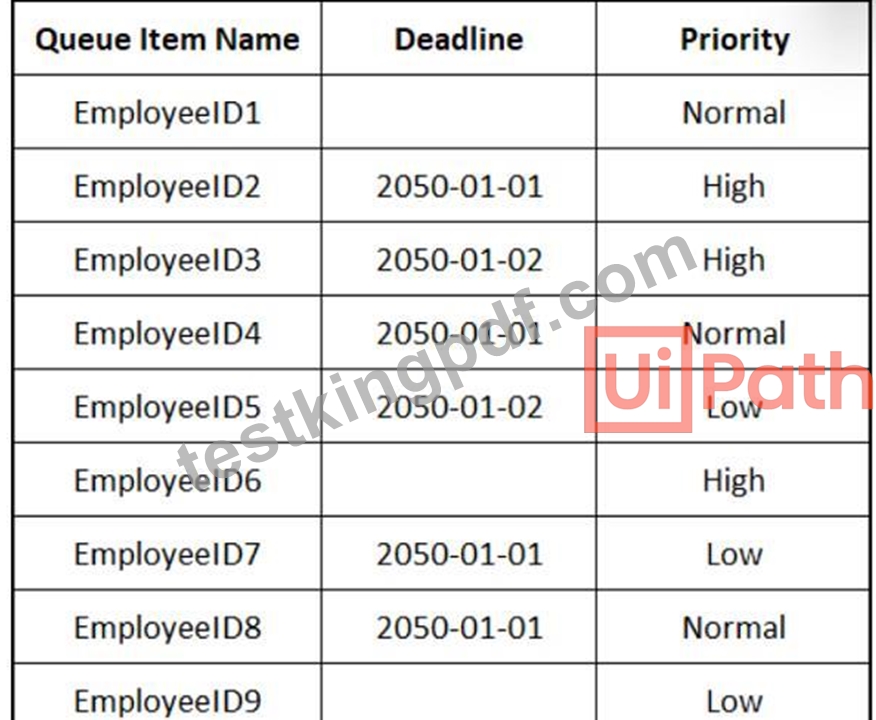
In what order should the Queue Items be processed by a single robot executing a Performer workflow?
Answer:
Explanation:
Explanation: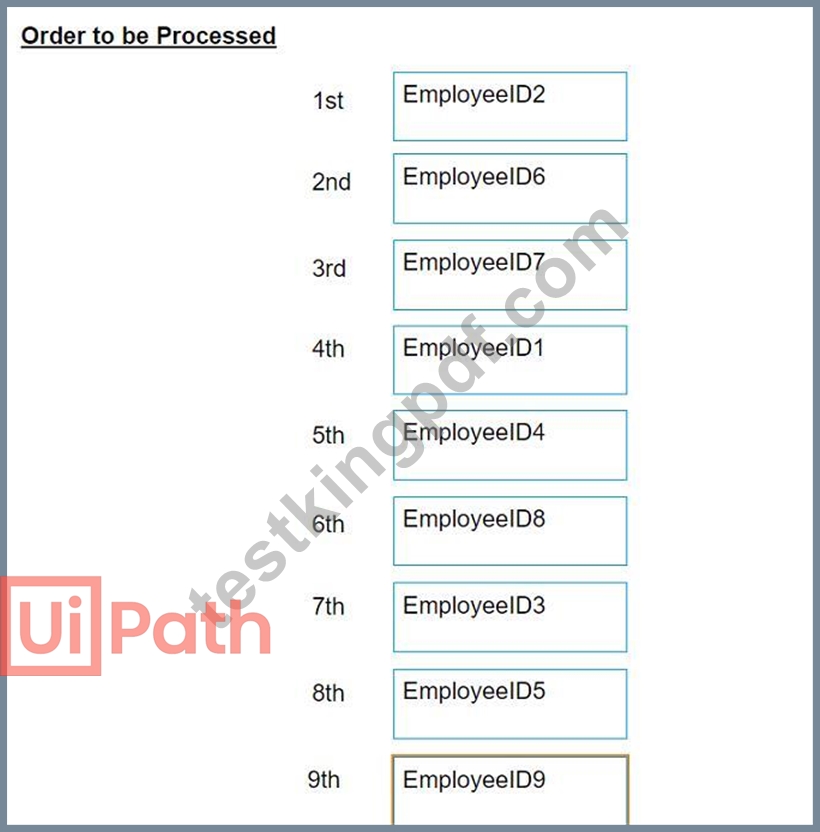
NEW QUESTION # 73
Which of the following options is correct about a State Machine layout?
- A. Can have multiple initial states and multiple final states.
- B. Can have only one initial state and only one final state.
- C. Can have multiple initial states and only one final state.
- D. Can have only one initial state and multiple final states.
Answer: D
Explanation:
The correct option about a State Machine layout is that it can have only one initial state and multiple final states. A State Machine is a type of workflow that consists of a set of states, transitions, and triggers. A state represents a stage of the process, a transition represents a change from one state to another, and a trigger represents a condition or an event that activates a transition. A State Machine can have only one initial state, which is the starting point of the workflow, and one or more final states, which are the end points of the workflow. A State Machine can also have intermediate states, which are the states between the initial and the final states. A State Machine can have multiple paths and branches, depending on the logic and the triggers of the workflow.
NEW QUESTION # 74
A developer has created a variable of type List of Strings named "Users_List", and initialized it with an empty list: "Users_List = new List(Of String)".
What is printed in the log message after the following Invoke Code is executed?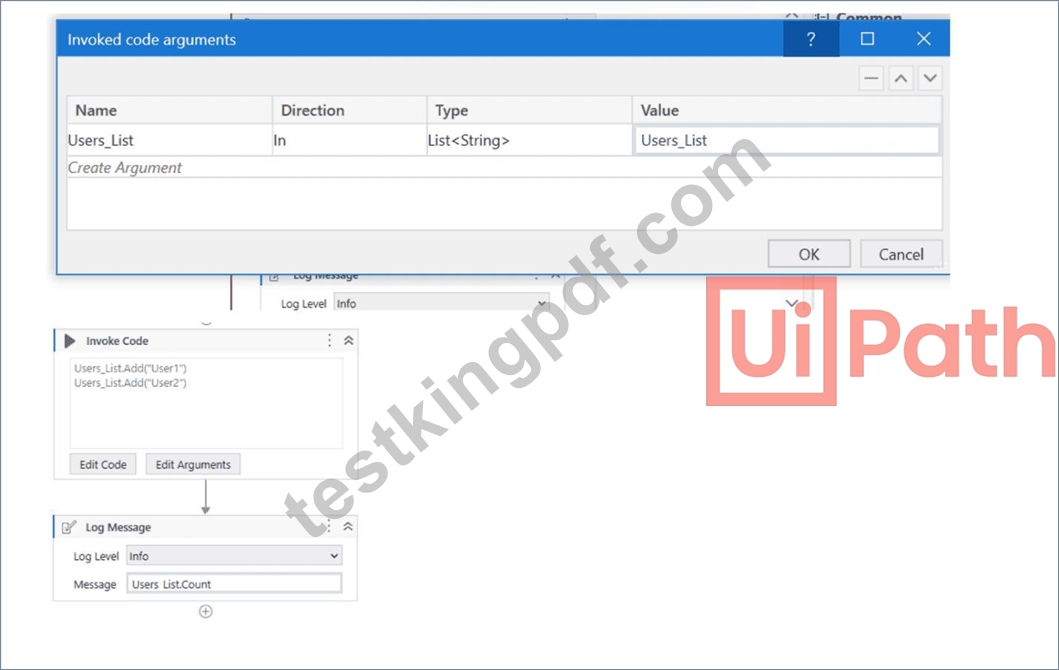
- A. Object reference not set to an instance exception is thrown
- B. 0
- C. System Argument Exception is thrown
- D. 1
Answer: D
Explanation:
The screenshot shows an "Invoke Code" activity in UiPath with the following VB.NET code:
Users_List.Add("User1")
Users_List.Add("User2")
According to the given information, the "Users_List" variable is a List of Strings that has been initialized with an empty list before the Invoke Code activity is run. The code within the Invoke Code activity is adding two strings: "User1" and "User2" to the "Users_List".
The Log Message activity following the Invoke Code is attempting to log the count of items in "Users_List", which would be the number of elements contained in the list at that time.
Given the steps that have been described, after the Invoke Code activity has run, the "Users_List" will contain two elements ("User1" and "User2"). Therefore, the log message will print the count of items in the list, which is:
B:2
So the correct answer is B, as the "Users_List" will have two elements and Users_List.Count will return the number 2.
The Invoke Code activity is used to execute VB.NET or C# code within a UiPath workflow1. The activity has the following properties:
* Code: The code that is to be executed. This field supports only strings and String variables1.
* Language: The language that the code is written in. The available options are VBNet and CSharp1.
* Arguments: The parameters that can be passed to and from the code1.
In this question, the developer has created a variable of type List of Strings named "Users_List", and initialized it with an empty list: "Users_List = new List(Of String)". Then, the developer has used the Invoke Code activity to execute the following code:
Users_List.Add("User1") Users_List.Add("User2")
This code adds two items ("User1" and "User2") to the "Users_List" variable. After the Invoke Code activity, the developer has used the Log Message activity to print the count of items in the "Users_List" variable, using the expression "Users_List.Count.ToString". This expression returns the number of items in the list as a string2. Therefore, the log message will print "2", as there are two items in the list
NEW QUESTION # 75
A developer configured the properties for a Click activity as shown below:
What happens if the activity cannot find its target at runtime?
- A. The next activity is executed after 10 seconds.
- B. An exception is thrown after 10 milliseconds.
- C. An exception is thrown after 10 seconds.
- D. The next activity is executed after 10 milliseconds.
Answer: C
Explanation:
The Click activity has a property called TimeoutMS. This property specifies the amount of time (in milliseconds) to wait for the activity to be executed before an error is thrown. In this case, the TimeoutMS property is set to 10000 milliseconds (10 seconds). Therefore, if the activity cannot find its target at runtime, an exception will be thrown after 10 seconds.
NEW QUESTION # 76
A developer wants to add items to a list of strings using the Invoke Method activity. The list is declared as follows: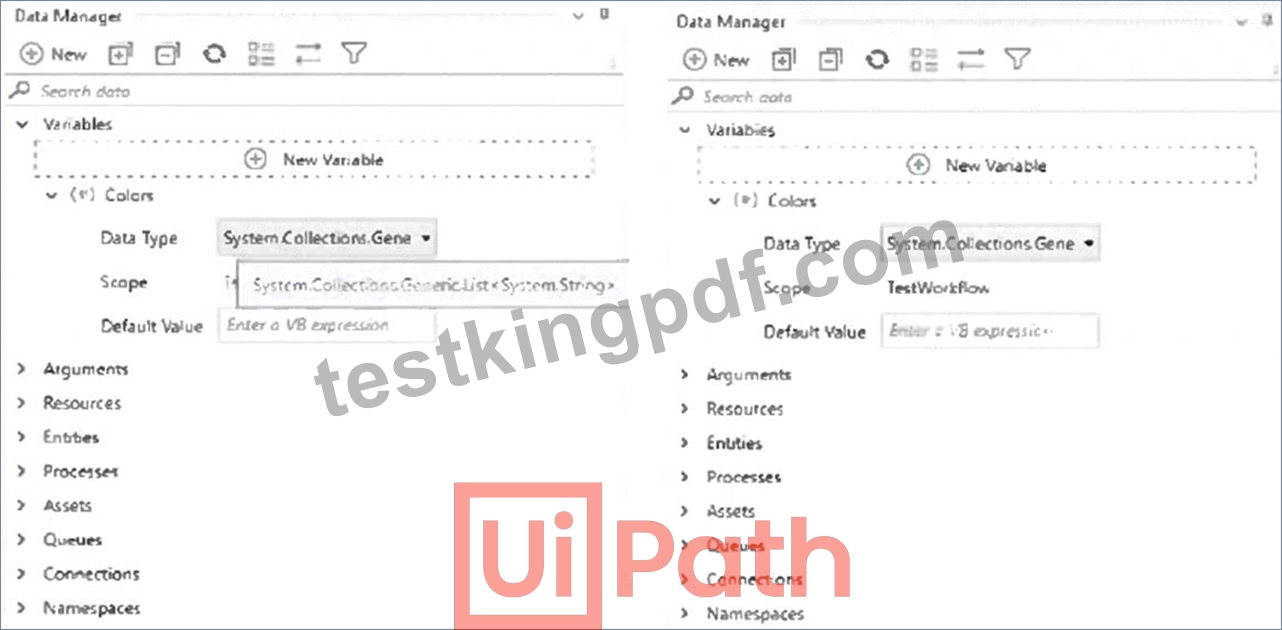
The Invoke Method activity has the following properties: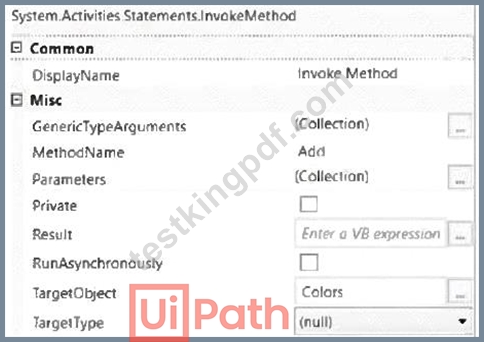
The Parameters property is as follows:
Based on the information shown in the exhibits what is the outcome of the Invoke Method activity?
- A. Colors will contain an item with the value "Colors: Yellow".
- B. An exception will be thrown.
- C. Colors will contain an item with the value "Yellow".
- D. Colors will contain an item with an empty value.
Answer: C
Explanation:
The Invoke Method activity is used to invoke a method of a class or an object. In this case, the developer wants to add items to a list of strings using the Invoke Method activity. The list is declared as follows:
Dim Colors As New List(Of String)
This means that the list is named Colors and it can store strings. The Invoke Method activity has the following properties:
TargetType: System.Collections.Generic.List`1[System.String]. This means that the target type is a generic list of strings.
TargetObject: Colors. This means that the target object is the list named Colors.
MethodName: Add. This means that the method name is Add, which is a method of the list class that adds an item to the end of the list.
Parameters: In, String, Yellow. This means that the parameter direction is In, which means that the value is passed to the method. The parameter type is String, which means that the value is a string. The parameter value is Yellow, which means that the value is the string "Yellow".
Based on the information shown in the exhibits, the outcome of the Invoke Method activity is that Colors will contain an item with the value "Yellow". This is because the Invoke Method activity will add "Yellow" to the list of strings declared as Colors.
NEW QUESTION # 77
What is the purpose of the Interval filter in the Orchestrator's Monitoring page?
- A. It enables you to sort the displayed data based on job priorities.
- B. It allows you to control the granularity of the displayed data and check the health of your system in either the last day or the last hour.
- C. It allows you to allocate licenses per machine for the displayed data.
- D. It allows you to choose between background and foreground processes for the displayed data.
Answer: B
Explanation:
The purpose of the Interval filter in the Orchestrator's Monitoring page is to allow you to control the granularity of the displayed data and check the health of your system in either the last day or the last hour. The Monitoring page provides various metrics and charts that show the status and performance of your robots, processes, queues, and transactions. The Interval filter lets you choose the time frame for the data that you want to see. You can select either the last day or the last hour as the interval. The data will be updated accordingly and show you the trends and changes in your system over the selected period. This can help you identify any issues or anomalies and take corrective actions if needed.
NEW QUESTION # 78
In UiPath Studio, how can a specific amount of time be subtracted from the current date using DateTime and TimeSpan variables in the VB.NET?
- A. Multiply the TimeSpan variable by -1 and then add it to the DateTime variable.
- B. Call Now.Subtract(Span) directly, without using a DateTime variable.
- C. Assign the subtraction result to a DateTime variable with the following syntax Today.Subtract(Span).
- D. Use the Add method on the DateTime variable and pass a negative TimeSpan value.
Answer: D
Explanation:
In UiPath Studio, you can use DateTime and TimeSpan variables to store and manipulate date and time values. A DateTime variable represents a specific point in time, such as the current date and time, or a date in the past or future. A TimeSpan variable represents a time interval, such as one hour, two days, or three weeks.
To subtract a specific amount of time from the current date using DateTime and TimeSpan variables in VB.
NET, you can use the Add method on the DateTime variable and pass a negative TimeSpan value. For example, if you have a DateTime variable called Today that stores the current date and time, and a TimeSpan variable called Span that stores the time interval you want to subtract, you can write:
Today.Add(-Span)
This expression returns a new DateTime value that is the result of subtracting the Span value from the Today value. For example, if Today is 2024-02-08 10:51:49 and Span is 1.02:10:04, then the expression returns
2024-02-07 08:41:45.
The other options are not correct ways of subtracting a TimeSpan value from a DateTime value in VB.NET.
Option A is invalid, because you cannot multiply a TimeSpan value by a number. Option B is incorrect, because the Subtract method on the DateTime variable returns a TimeSpan value, not a DateTime value.
Option D is incorrect, because the Now property is not a method, and it cannot take a TimeSpan value as an argument.
References: Variables - Date and Time Variables - UiPath Documentation Portal, DateTime.Add Method (System) - Microsoft Docs, DateTime.Subtract Method (System) - Microsoft Docs, Date and Time Arithmetic
- UiPath Community Forum
NEW QUESTION # 79
The following table is stored in a variable called "dt".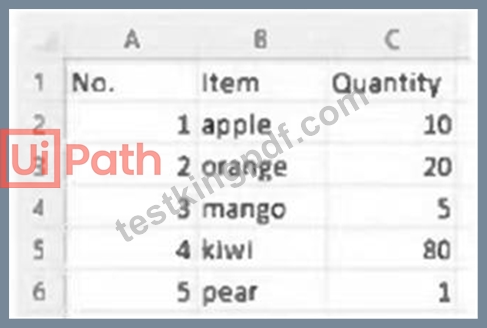
What will the value of the qty variable be after executing the Assign activity?
- A. 0
- B. 1
- C. 2
- D. null
Answer: C
Explanation:
The value of the qty variable will be 80 after executing the Assign activity. This is because the expression in the Assign activity is using the LINQ methods AsEnumerable, SkipWhile, and Item to access the data in the dt variable. The dt variable is a DataTable that contains the following data:
Item
Quantity
apple
5
banana
10
mango
20
orange
80
grape
40
The AsEnumerable method converts the DataTable into an Enumerable collection of DataRow objects. The SkipWhile method skips the elements of the collection until the condition is false. The condition is a lambda expression that checks if the value of the Item column is equal to "mango". The (0) indexer returns the first element of the collection after skipping. The Item method accesses the value of the Quantity column of the DataRow. The ToString method converts the value into a string. Therefore, the expression will skip the first three rows of the DataTable and return the value of the Quantity column of the fourth row, which is
80. References: [DataTable.AsEnumerable Method], [Enumerable.SkipWhile Method], [DataRow.Item Property]
NEW QUESTION # 80
A developer needs to use the REFramework in order to implement a linear process. Which value should be set to "out_Transactionltem" the first time when it enters the Get Transaction Data state?
- A. It should be set to the next queue item in order to be, further on, processed.
- B. The process will not enter the Get Transaction Data state because a linear process is not transactional.
- C. It should be set to Nothing because a linear process should not enter the second time in the Get Transaction Data state.
- D. It can be set to a static value and. in order to respect the UiPath best practices, this value should be taken from "Config.xlsx".
Answer: C
Explanation:
The out_TransactionItem argument is an output argument of the GetTransactionData workflow, which is used to store the data of the current transaction item1. The REFramework is a template for creating robust and scalable automation projects that uses the State Machine workflow type2. The REFramework is designed for transactional processes, which are processes that handle multiple items of data in a loop3. However, it can also be adapted for linear processes, which are processes that execute a sequence of actions only once.
To use the REFramework for a linear process, the out_TransactionItem argument should be set to Nothing the first time when it enters the Get Transaction Data state. This will ensure that the process will not enter the Get Transaction Data state again, as the condition for the transition from the Get Transaction Data state to the Process Transaction state is out_TransactionItem isNot Nothing1. Setting the out_TransactionItem argument to Nothing will also trigger the End Process state, which will perform the final actions and close the application1.
Option A is incorrect, because the process will enter the Get Transaction Data state even if it is a linear process, as it is the first state in the REFramework. Option B is incorrect, because there is no queue item in a linear process, as there is only one item of data to be processed. Option D is incorrect, because setting the out_TransactionItem argument to a static value will cause the process to enter the Get Transaction Data state repeatedly, as the condition for the transition will always be true.
References: 1: The UiPath ReFramework 2: State Machine 3: Transactional Business Process : [Linear Business Process]
NEW QUESTION # 81
Data from an Excel file is read into a data table named "dtEmployee", as displayed in the following graphic: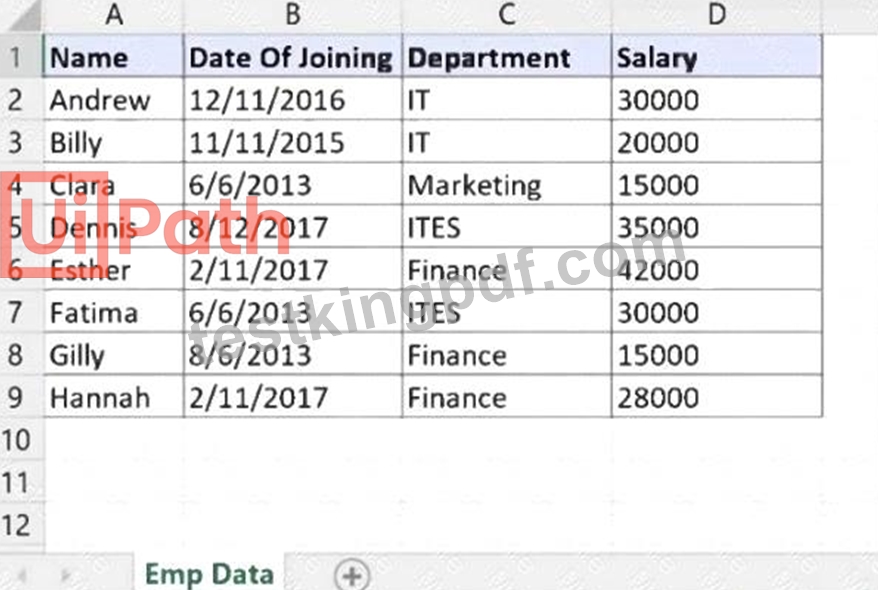
A developer needs to filter the data table to obtain all rows representing employees from the Finance and IT departments with a Salary under 30,000. Which expression yields the desired outcomes?
- A. dtEmployee.Select("([Department]='IT' OR [Department]='Finance') AND [Salary] < 30000")
- B. dtEmployee.Select("([Department]='IT' AND [Department]='Finance') AND [Salary] < 30000")
- C. dtEmployee.Select("[Department]='IT OR [Department]='Finance' OR [Salary] < 30000")
- D. dtEmployee.Select("[Department]='IT' OR [Department]= 'Finance' AND [Salary] < 30000")
Answer: A
NEW QUESTION # 82
Starting with UiPath Studio version 2022.10, what happens to dependencies that lack Windows compatibility when they are converted in a project?
- A. They are removed from the project.
- B. They are replaced with compatible alternatives.
- C. They are automatically resolved.
- D. They are marked as unresolved.
Answer: D
NEW QUESTION # 83
What is the use of job priorities in unattended automations within UiPath Orchestrator?
- A. To determine which processes should be executed first when dealing with multiple jobs.
- B. To sort and organize tasks within a folder.
- C. To determine machine resource allocation among processes.
- D. To create job dependencies that must be completed before new job execution.
Answer: A
Explanation:
The use of job priorities in unattended automations within UiPath Orchestrator is to determine which processes should be executed first when dealing with multiple jobs. Job priorities are values that can be assigned to jobs or triggers when they are created or edited. The possible values are High, Normal, and Low.
Job priorities affect the order in which the jobs are executed by the robots, with higher priority jobs being executed before lower priority jobs. Job priorities can help you to optimize the execution of your unattended automations, especially when you have limited resources or time-sensitive processes. You can also use job priorities to create job dependencies that must be completed before new job execution, by using the Start Job activity with the Wait for completion option and setting the priority of the child job to High. References: [Job Priority], [Start Job]
NEW QUESTION # 84
Starting with UiPath Studio version 2022.10, what happens to dependencies that lack Windows compatibility when they are converted in a project?
- A. They are removed from the project.
- B. They are replaced with compatible alternatives.
- C. They are automatically resolved.
- D. They are marked as unresolved.
Answer: D
Explanation:
Starting with UiPath Studio version 2022.10, dependencies that lack Windows compatibility are marked as unresolved when they are converted in a project. This means that the project cannot be executed until the unresolved dependencies are manually resolved by the developer. This is done to ensure that the project can run on both Windows and Linux platforms without compatibility issues. References: [UiPath Studio Guide - Converting Projects to Linux Compatibility]
NEW QUESTION # 85
Given a dataiable "dt" with the following header:
"Surname. Address. Zip Code, Given Name, Phone Number.
What is the correct configuration of the Invoke Method activity so that the resulting header will be:
"Surname. Given Name. Address. Zip Code. Phone Number".
- A.

- B.

- C.
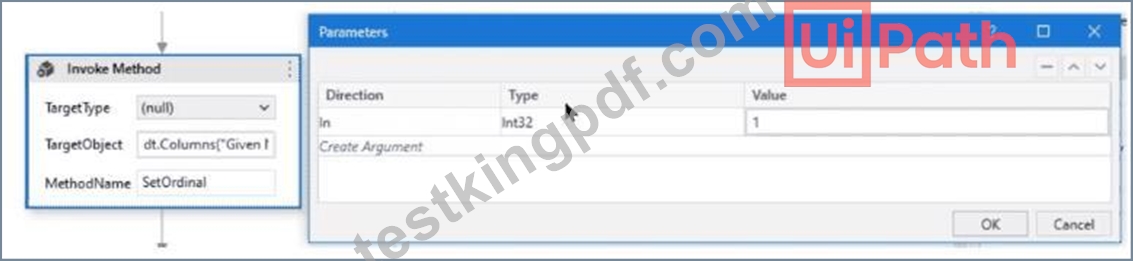
- D.

Answer: C
NEW QUESTION # 86
Given the following list of arguments: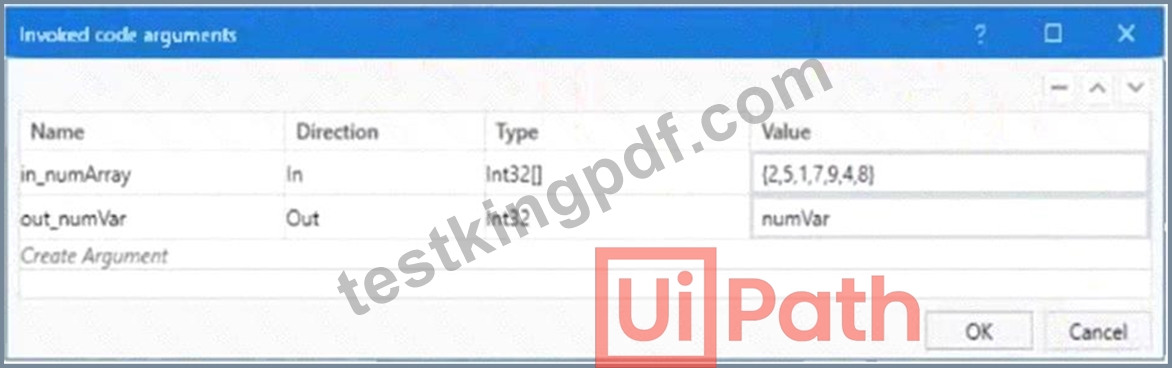
and the following code:
What is the value that will be displayed in the Output Panel at the end of the sequence below:
- A. 0
- B. 1
- C. 2
- D. 3
Answer: B
Explanation:
The value that will be displayed in the Output Panel at the end of the sequence is 9. This is because the code in the Invoke Code activity is looping through the array in_numArray and setting the variable out_numVar to the highest value in the array. The array in_numArray has the values {1, 2, 7, 9, 4} as shown in the list of arguments. The variable out_numVar is initialized to 0. The For loop iterates from 0 to the upper bound of the array, which is 4. In each iteration, the If condition checks if the current element of the array is greater than the current value of out_numVar. If it is, then out_numVar is assigned to the current element of the array.
Otherwise, out_numVar remains unchanged. Therefore, after the first iteration, out_numVar becomes 1. After the second iteration, out_numVar becomes 2. After the third iteration, out_numVar becomes 7. After the fourth iteration, out_numVar becomes 9. After the fifth iteration, out_numVar remains 9, since 4 is not greater than 9. The Write Line activity outputs the value of out_numVar to the console, which is
9. References: Invoke Code
NEW QUESTION # 87
In the context of a process automated using the REFramework that processes payments and sends a report using the Finance team leader's email account at the end of the day. where should the email account credentials be stored according to best practices''
- A. In an Orchestrator Credential asset and referenced in the Assets sheet in the Config.xlsx file.
- B. In an Orchestrator Credential asset and referenced in the Settings sheet in the Config.xlsx file.
- C. In the Constants sheet in the Config.xlsx file with the value of the email address.
- D. In an Orchestrator Text asset and referenced in the Assets sheet In the Config.xlsx file.
Answer: A
Explanation:
In the REFramework, best practices suggest storing sensitive information like email account credentials in an Orchestrator Credential asset. This asset is then referenced in the Config.xlsx file, specifically in the Assets sheet, ensuring secure and centralized management of credentials.
NEW QUESTION # 88
......
Download Real UiPath UiPath-ADPv1 Exam Dumps Test Engine Exam Questions: https://prepaway.testkingpdf.com/UiPath-ADPv1-testking-pdf-torrent.html
