

Best Quality Splunk SPLK-1003 Exam Questions PrepAway Realistic Practice Exams [2024]
Critical Information To Splunk Enterprise Certified Admin Pass the First Time
NEW QUESTION # 93
Which Splunk component does a search head primarily communicate with?
- A. Indexer
- B. Cluster master
- C. Forwarder
- D. Deployment server
Answer: D
NEW QUESTION # 94
What is the name of the object that stores events inside of an index?
- A. Indexer
- B. Data layer
- C. Bucket
- D. Container
Answer: C
Explanation:
A bucket is the object that stores events inside of an index. According to the Splunk documentation1, "An index is a collection of directories, also called buckets, that contain index files. Each bucket represents a specific time range." A bucket can be in one of several states, such as hot, warm, cold, frozen, or thawed1. Buckets are managed by indexers or clusters of indexers1.
NEW QUESTION # 95
A Universal Forwarder has the following active stanza in inputs . conf:
[monitor: //var/log]
disabled = O
host = 460352847
An event from this input has a timestamp of 10:55. What timezone will Splunk add to the event as part of indexing?
- A. The timezone of the forwarder.
- B. Universal Coordinated Time.
- C. The timezone of the search head.
- D. The timezone of the indexer that indexed the event.
Answer: A
Explanation:
The correct answer is D. The timezone of the forwarder will be added to the event as part of indexing.
According to the Splunk documentation1, Splunk software determines the time zone to assign to a timestamp using the following logic in order of precedence:
Use the time zone specified in raw event data (for example, PST, -0800), if present.
Use the TZ attribute set in props.conf, if the event matches the host, source, or source type that the stanza specifies.
If the forwarder and the receiving indexer are version 6.0 or higher, use the time zone that the forwarder provides.
Use the time zone of the host that indexes the event.
In this case, the event does not have a time zone specified in the raw data, nor does it have a TZ attribute set in props.conf. Therefore, the next rule applies, which is to use the time zone that the forwarder provides. A universal forwarder is a lightweight agent that can forward data to a Splunk deployment, and it knows its system time zone and sends that information along with the events to the indexer2. The indexer then converts the event time to UTC and stores it in the _time field1.
The other options are incorrect because:
A) Universal Coordinated Time (UTC) is not the time zone that Splunk adds to the event as part of indexing, but rather the time zone that Splunk uses to store the event time in the _time field. Splunk software converts the event time to UTC based on the time zone that it determines from the rules above1.
B) The timezone of the search head is not relevant for indexing, as the search head is a Splunk component that handles search requests and distributes them to indexers, but it does not process incoming data3. The search head uses the user's timezone setting to determine the time range in UTC that should be searched and to display the timestamp of the results in the user's timezone2.
C) The timezone of the indexer that indexed the event is only used as a last resort, if none of the other rules apply. In this case, the forwarder provides the time zone information, so the indexer does not use its own time zone1.
NEW QUESTION # 96
Which option accurately describes the purpose of the HTTP Event Collector (HEC)?
- A. A token-based HTTP input that is insecure and non-scalable and that does not require the use of forwarders.
- B. An agent-based HTTP input that is secure and scalable and that does not require the use of forwarders.
- C. A token-based HTTP input that is secure and scalable and that does not require the use of forwarders.
- D. A token-based HTTP input that is secure and scalable and that requires the use of forwarders.
Answer: C
Explanation:
Explanation/Reference: http://dev.splunk.com/view/event-collector/SP-CAAAE6M
NEW QUESTION # 97
Which of the following enables compression for universal forwarders in outputs. conf ?
A)
B)
C)
D)
- A. Option A
- B. Option C
- C. Option B
- D. Option D
Answer: C
NEW QUESTION # 98
When configuring monitor inputs with whitelists or blacklists, what is the supported method of filtering the lists?
- A. Regular expression
- B. Irregular expression
- C. Slash notation
- D. Wildcard-only expression
Answer: A
Explanation:
https://docs.splunk.com/Documentation/Splunk/latest/Data/Whitelistorblacklistspecificincomingdata#Include_or_exclude_specific_incoming_data
NEW QUESTION # 99
Which parent directory contains the configuration files in Splunk?
$SPLUNK_HOME/etc
- A. $SPLUNK_HOME/default
- B. $SPLUNK_HOME/var
- C. $SPLUNK_HOME/conf
Answer: B
Explanation:
Explanation/Reference: https://docs.splunk.com/Documentation/Splunk/7.3.1/Admin/Configurationfiledirectories
NEW QUESTION # 100
To set up a Network input in Splunk, what needs to be specified'?
- A. Network protocol and port number.
- B. File path.
- C. Username and password
- D. Network protocol and MAC address.
Answer: A
Explanation:
Explanation
https://docs.splunk.com/Documentation/Splunk/8.0.3/Data/Monitornetworkports
NEW QUESTION # 101
How would you configure your distsearch conf to allow you to run the search below? sourcetype=access_combined status=200 action=purchase splunk_setver_group=HOUSTON A)
B)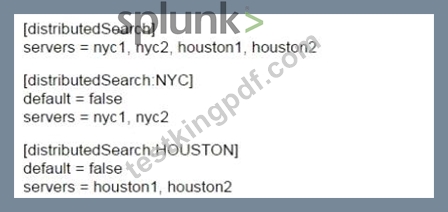
C)
D)
- A. option A
- B. Option B
- C. Option C
- D. Option D
Answer: C
NEW QUESTION # 102
To set up a Network input in Splunk, what needs to be specified'?
- A. Network protocol and port number.
- B. File path.
- C. Username and password
- D. Network protocol and MAC address.
Answer: A
Explanation:
https://docs.splunk.com/Documentation/Splunk/8.0.3/Data/Monitornetworkports
NEW QUESTION # 103
After automatic load balancing is enabled on a forwarder, the time interval for switching indexers can be updated by using which of the following attributes?
- A. channelTTL
- B. secsInFailurelnterval
- C. connectionTimeout
- D. autoLBFrequency
Answer: D
NEW QUESTION # 104
Which of the following is a valid distributed search group?
- A. [searchGroup:Paris] default = false servers = server1:9997, server2:9997
- B. [distributedSearch:Paris] default = false servers = server1, server2
- C. [searchGroup:Paris] default = false servers = server1:8089, server2:8089
- D. [distributedSearch:Paris] default = false servers = server1:8089; server2:8089
Answer: D
NEW QUESTION # 105
What are the values for host and index for [stanza1] used by Splunk during index time, given the following configuration files?
- A. host=unixsvr1
index=unixinfo - B. host=searchsvr1
index=searchinfo - C. host=server1
index=searchinfo - D. host=server1
index=unixinfo
Answer: A
NEW QUESTION # 106
Which of the following are supported options when configuring optional network inputs?
- A. Metadata override, sender filtering options, network input queues (quantum queues)
- B. Filename override, sender filtering options, network output queues (memory/persistent queues)
- C. Metadata override, sender filtering options, network input queues (memory/persistent queues)
- D. Metadata override, receiver filtering options, network input queues (memory/persistent queues)
Answer: D
NEW QUESTION # 107
How would you configure your distsearch conf to allow you to run the search below? sourcetype=access_combined status=200 action=purchase splunk_setver_group=HOUSTON A)
B)
C)
D)
- A. option A
- B. Option B
- C. Option C
- D. Option D
Answer: C
Explanation:
https://docs.splunk.com/Documentation/Splunk/8.0.3/DistSearch/Distributedsearchgroups
NEW QUESTION # 108
Which of the following statements describes how distributed search works?
- A. Search heads store a portion of the searchable data.
- B. Forwarders pull data from the search peers.
- C. The search head dispatches searches to the search peers.
- D. Search results are replicated within the indexer cluster.
Answer: C
Explanation:
Explanation
URLhttps://docs.splunk.com/Documentation/Splunk/8.2.2/DistSearch/Configuredistributedsearch
"To activate distributed search, you add search peers, or indexers, to a Splunk Enterprise instance that you desingate as a search head. You do this by specifying each search peer manually."
NEW QUESTION # 109
Which of the following apply to how distributed search works? (Choose all that apply.)
- A. The search peers pull the data from the forwarders.
- B. The search head dispatches searches to the peers.
- C. The search head consolidates the individual results and prepares reports.
- D. Peers run searches in parallel and return their portion of results.
Answer: C
Explanation:
Explanation/Reference:
https://docs.splunk.com/Documentation/Splunk/7.3.1/Indexer/Howclusteredsearchworks
NEW QUESTION # 110
Which default Splunk role could be assigned to provide users with the following capabilities?
Create saved searches
Edit shared objects and alerts
Not allowed to create custom roles
- A. admin
- B. power
- C. user
- D. splunk-system-role
Answer: B
Explanation:
Reference:
The power role is a default Splunk role that grants users the ability to create saved searches, edit shared objects and alerts, and access advanced search commands. However, the power role does not allow users to create custom roles, which is a privilege reserved for the admin role. Therefore, option B is the correct answer. Reference: Splunk Enterprise Certified Admin | Splunk, [About configuring role-based user access - Splunk Documentation]
NEW QUESTION # 111
The universal forwarder has which capabilities when sending data? (select all that apply)
- A. Compressing data
- B. Indexer acknowledgement
- C. Obfuscating/hiding data
- D. Sending alerts
Answer: B
NEW QUESTION # 112
Which of the following types of data count against the license daily quota?
- A. Replicated data
- B. Windows internal logs
- C. splunkd logs
- D. Summary index data
Answer: C
NEW QUESTION # 113
Which optional configuration setting in inputs .conf allows you to selectively forward the data to specific indexer(s)?
- A. _INDEXER ROUTING
- B. _INDEXER_LIST
- C. _INDEXER_GROUP
- D. _TCP_ROUTING
Answer: C
NEW QUESTION # 114
After an Enterprise Trial license expires, it will automatically convert to a Free license. How many days is an Enterprise Trial license valid before this conversion occurs?
- A. 60 days
- B. 90 days
- C. 14 days
- D. 7 days
Answer: A
Explanation:
Reference:
https://docs.splunk.com/Documentation/Splunk/8.2.3/Admin/TypesofSplunklicenses
NEW QUESTION # 115
What action is required to enable forwarder management in Splunk Web?
- A. Navigate to Settings > Server Settings > General Settings, and set an App server port.
- B. Place an app in the SPLUNK_HOME/etc/deployment-apps directory of the deployment server.
- C. Navigate to Settings > Forwarding and receiving, and click on Enable Forwarding.
- D. Create a server class and map it to a client in SPLUNK_HOME/etc/system/local/serverclass.conf.
Answer: D
Explanation:
Reference:
https://docs.splunk.com/Documentation/MSApp/2.0.3/MSInfra/Setupadeploymentserver
"To activate deployment server, you must place at least one app into %SPLUNK_HOME%\etc\deployment-apps on the host you want to act as deployment server. In this case, the app is the "send to indexer" app you created earlier, and the host is the indexer you set up initially.
NEW QUESTION # 116
Which pathway represents where a network input in Splunk might be found?
- A. $SPLUNK HOME/ etc/ apps/ ne two r k/ inputs.conf
- B. $SPLUNK HOME/ etc/ apps/ $appName/ local / inputs.conf
- C. $SPLUNK HOME/ var/lib/ splunk/$inputName/homePath/
- D. $SPLUNK HOME/ system/ local /udp.conf
Answer: B
Explanation:
The correct answer is B. The network input in Splunk might be found in the $SPLUNK_HOME/etc/apps/$appName/local/inputs.conf file.
A network input is a type of input that monitors data from TCP or UDP ports. To configure a network input, you need to specify the port number, the connection host, the source, and the sourcetype in the inputs.conf file. You can also set other optional settings, such as index, queue, and host_regex1.
The inputs.conf file is a configuration file that contains the settings for different types of inputs, such as files, directories, scripts, network ports, and Windows event logs. The inputs.conf file can be located in various directories, depending on the scope and priority of the settings. The most common locations are:
$SPLUNK_HOME/etc/system/default: This directory contains the default settings for all inputs. You should not modify or copy the files in this directory2.
$SPLUNK_HOME/etc/system/local: This directory contains the custom settings for all inputs that apply to the entire Splunk instance. The settings in this directory override the default settings2.
$SPLUNK_HOME/etc/apps/$appName/default: This directory contains the default settings for all inputs that are specific to an app. You should not modify or copy the files in this directory2.
$SPLUNK_HOME/etc/apps/$appName/local: This directory contains the custom settings for all inputs that are specific to an app. The settings in this directory override the default and system settings2.
Therefore, the best practice is to create or edit the inputs.conf file in the $SPLUNK_HOME/etc/apps/$appName/local directory, where $appName is the name of the app that you want to configure the network input for. This way, you can avoid modifying the default files and ensure that your settings are applied to the specific app.
The other options are incorrect because:
A) There is no network directory under the apps directory. The network input settings should be in the inputs.conf file, not in a separate directory.
C) There is no udp.conf file in Splunk. The network input settings should be in the inputs.conf file, not in a separate file. The system directory is not the recommended location for custom settings, as it affects the entire Splunk instance.
D) The var/lib/splunk directory is where Splunk stores the indexed data, not the input settings. The homePath setting is used to specify the location of the index data, not the input data. The inputName is not a valid variable for inputs.conf.
NEW QUESTION # 117
Consider the following stanza in inputs.conf:
What will the value of the source filed be for events generated by this scripts input?
- A. unknown
- B. /opt/splunk/ecc/apps/search/bin/liscer.sh
- C. liscer.sh
- D. liscer
Answer: D
NEW QUESTION # 118
......
SPLK-1003 EXAM DUMPS WITH GUARANTEED SUCCESS: https://prepaway.testkingpdf.com/SPLK-1003-testking-pdf-torrent.html
